
Lone Star Floating Catfish Food
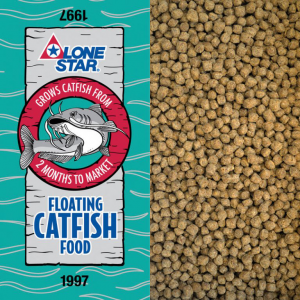
Are you looking for an economical way to grow catfish from fingerlings to market size without sacrificing quality? Raising healthy, fast-growing fish requires a dependable feed that delivers consistent results. At Crockett Farm & Fuel, we provide a reliable, budget-friendly solution with Lone Star Floating Catfish Food. This complete ration is specifically designed to be fed to catfish from two months of age and older, providing the essential nutrients they need for rapid and efficient growth.
We recommend Lone Star because it offers a high-performance formula at an excellent value. With 32% protein, it fuels the development of strong, healthy fish, helping you reach your target market size faster. The 3/16-inch pellets float on the surface, which allows you to easily monitor your fish as they eat. This helps prevent overfeeding, reduces waste, and ensures your catfish are consuming the nutrients they need. It is the ideal choice for pond owners who want a straightforward, effective feeding program that maximizes growth without breaking the bank.
Key Features & Benefits:
- High-Protein Formula: Contains 32% protein to support rapid growth from fingerling to market size.
- Floating Ration: The 3/16-inch pellets float, allowing you to monitor feeding activity and reduce waste.
- Economical Growth: An affordable, high-quality feed designed to provide excellent value for pond owners.
- Complete Nutrition: Provides a balanced diet for catfish two months and older, supporting overall health and development.
Get your catfish to market faster.
Visit Crockett Farm & Fuel today to pick up a bag of Lone Star Floating Catfish Food. Let our team help you find the right feed to achieve your pond management goals.
Features
- 32% protein
- 3/16 inch pellet
- Floating ration
BENEFITS
- An economical ration for growing catfish from fingerling size to market
Directions
The amount of feed utilized by the fish depends primarily on water temperature and the size of the fish. However, the rate should not exceed 25 pounds per surface acre of water regardless of the number and weight of the fish. Fish grow best when the water temperature is above 70 degrees F. Typically, the amount of feed taken by the fish will vary directly with the temperature. Use the table below as a guide for feeding channel catfish from fingerlings to market or harvest size. Fish should not be fed more than they will eat in a 24-hour period.
SUGGESTED FEEDING RATES
| WATER TEMPERATURE | AMOUNT OF FEED |
| Above 70 degrees F | 3% of estimated total weight of fish |
| 60 to 70 degrees F | 2% of estimated total weight of fish |
| 45 to 60 degrees F | 1% of estimated total weight of fish |
| *Below 45 degrees F | Usually no feed |
*A small amount of feed may be necessary if low temperature is prolonged. In cold weather, growth will be slow or nonexistent. During extended low water temperatures in the winter, a certain amount of feed is necessary to maintain weight.
If this feeding guide is used, the estimated total weight of all fish in a given pond must be determined each month. A simple procedure can be followed:
1. Collect by seine or other method, approximately 100 fish from the pond.
2. Count and weigh the fish. Return the fish to the pond as soon as possible.
3. Obtain the average weight per fish by dividing the number of fish collected into the pounds of fish collected.
4. Obtain estimated total weight by multiplying average weight of a single fish by the total number stacked in the ponds.
5. Calculate pounds of feed needed by multiplying the estimated total weight by the percentage of required food indicated in the above table.
Growing fish should be fed 6 days a week and at the same time and place. During cool weather, feed the fish when the highest daily temperature occurs (approximately 3:00 P.M.). Continue feeding until the fish are the desired size.
Caution: Feed should be stored in a well-ventilated, dry area that is protected from rodents and insects. Feed is perishable. Do not feed moldy or insect-infested feed as it may cause illness or death.
Ingredients
Plant protein products, grain products, processed grain by-products, animal protein products, salt, vitamin A supplement, vitamin D3 supplement, vitamin E supplement, vitamin B12 supplement, riboflavin supplement, niacin supplement, calcium pantothenate, choline chloride, menadione sodium bisulfite complex (source of vitamin K activity), folic acid, pyridoxine hydrochloride, thiamine mononitrate, sodium selenite, biotin, L-ascorbyl-2-polyphosphate (source of vitamin C), manganese sulfate, zinc sulfate, ferrous sulfate, copper sulfate, ethylenediamine dihydroiodide.
Guaranteed Analysis
| Crude Protein, min | 32.00 | % |
| Crude Fat, min | 3.00 | % |
| Crude Fiber, max | 5.00 | % |
| Phosphorus (P), min | 0.50 | % |
| DIGESTIBLE ENERGY | 1078.07 | Kcal/lb |
| PROTEIN | 32.04 | % |
| ARGININE | 2.01 | % |
| GLYCINE | 1.71 | % |
| HISTIDINE | 0.73 | % |
| ISOLEUCINE | 1.32 | % |
| LEUCINE | 2.34 | % |
| LYSINE | 1.71 | % |
| METHIONINE | 0.44 | % |
| CYSTINE | 0.48 | % |
| PHENYLALANINE | 1.24 | % |
| TYROSINE | 0.88 | % |
| SERINE | 1.25 | % |
| THREONINE | 1.11 | % |
| TRYPTOPHANE | 0.38 | % |
| VALINE | 1.45 | % |
| FAT | 3.13 | % |
| FIBER | 3.92 | % |
| ASH | 7.16 | % |
| CALCIUM | 1.04 | % |
| POTASSIUM | 1.30 | % |
| CHLORINE | 0.20 | % |
| MAGNESIUM | 0.34 | % |
| SODIUM | 0.21 | % |
| SULFUR | 0.30 | % |
| COPPER | 8.06 | mg/lb |
| IRON | 86.05 | mg/lb |
| MANGANESE | 19.05 | mg/lb |
| SELENIUM | 0.15 | mg/lb |
| ZINC | 25.44 | mg/lb |
| BIOTIN | 0.15 | mg/lb |
| CHOLINE | 913.22 | mg/lb |
| FOLIC ACID | 1.10 | mg/lb |
| NIACIN | 45.77 | mg/lb |
| PANTOTHENIC ACID | 16.94 | mg/lb |
| VITAMIN B6 | 6.43 | mg/lb |
| RIBOFLAVIN | 6.19 | mg/lb |
| THIAMINE | 6.14 | mg/lb |
| VITAMIN B12 | 4.44 | mg/lb |
| VITAMIN E | 30.56 | mg/lb |
| VITAMIN A | 3.00 | KIU/lb |
| VITAMIN D3 | 0.90 | KIU/lb |
| VITAMIN K | 2.02 | mg/lb |
| VITAMIN C | 25.03 | mg/lb |